TMJ & Jaw
Treatment in
Busan,
Korea
📍 Busanjin-gu, Seomyeon | 🦷 TMJ & Occlusion Specialist | 🌐 English OK
CS Dental Hospital in Busan Seomyeon offers specialist-level TMJ (temporomandibular joint) and occlusion treatment. Jaw clicking, pain, restricted opening, headaches, teeth grinding, and bite dysfunction — all diagnosed with precise occlusal analysis, Gothic arch examination, and treated with evidence-based splint therapy and bite correction. One of the few dental hospitals in Busan with a dedicated TMJ and occlusion specialist team.
CS Dental Hospital treats jaw joint pain, clicking, headaches, and bite dysfunction in Busan Seomyeon using Gothic arch examination, splint therapy, and occlusion correction. Specialist-level TMJ diagnosis and treatment — 1-min from Seomyeon Station.
Specialist-level jaw diagnosis.
International patients welcome.
TMJ & Jaw Joint Pain — What Is It and How Is It Treated in Busan?
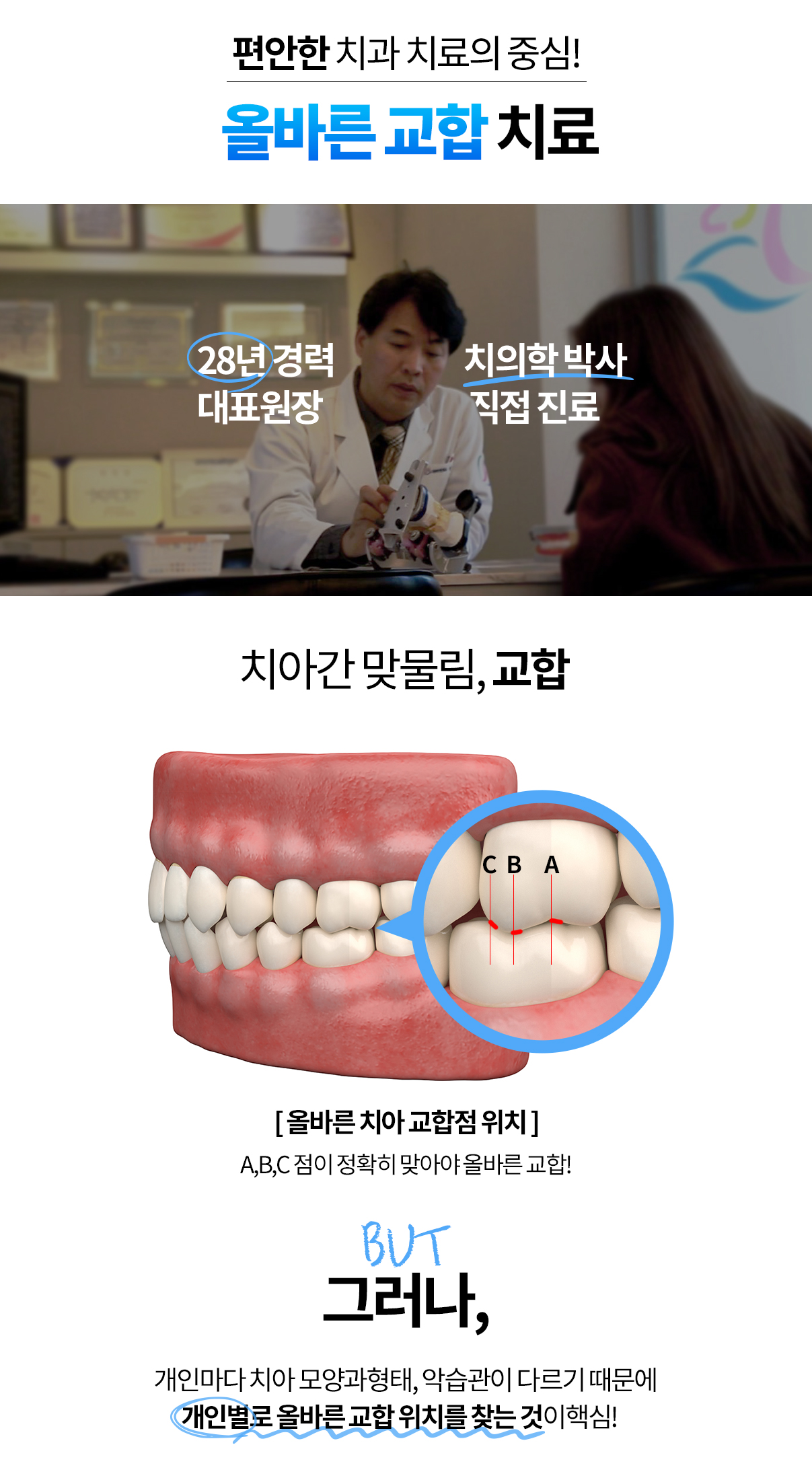
The temporomandibular joint (TMJ) is the hinge joint that connects your jaw to your skull. It is one of the most complex joints in the body — controlling opening, closing, chewing, speaking, and lateral jaw movements. When the TMJ is under stress, misaligned, or structurally compromised, it can cause a wide range of symptoms that extend far beyond the jaw itself: facial pain, headaches, ear symptoms, neck tension, and tooth wear.
TMJ disorder (TMD) is among the most underdiagnosed and undertreated conditions in dentistry. Many patients in Busan experiencing jaw clicking, morning headaches, or bite discomfort are told nothing is wrong — because diagnosing TMD requires specialist-level occlusal analysis tools that most general dental clinics do not have. CS Dental Hospital uses Gothic arch examination(고딕아치 검사) — a precision bite mapping technique that identifies the true centric relation of the jaw — as a baseline for all TMJ diagnosis and treatment planning.
Common TMJ Symptoms Treated at CS Dental Busan
- Jaw joint clicking or popping (clicking sound when opening or closing)
- Jaw pain — especially in the morning or after eating
- Limited jaw opening or jaw locking (trismus)
- Chronic headaches and temporal/facial muscle tension
- Teeth grinding (bruxism) — particularly during sleep
- Uneven bite — one side feels higher or contacts differently
- Ear pain or tinnitus associated with jaw function
- Neck and shoulder tension connected to jaw muscle imbalance
What Is Occlusion Treatment and Why Does It Matter?
Occlusion refers to the relationship between your upper and lower teeth — how they contact each other during biting, chewing, and at rest. When this relationship is imbalanced, uneven forces are transmitted to the jaw joints and muscles with every bite. Over time, this creates cumulative stress that manifests as TMJ pain, tooth wear, fractured restorations, and headaches.
CS Dental Hospital's occlusion treatment program corrects the bite systematically: using Gothic arch examination to identify the ideal jaw position, then progressively equilibrating the bite through selective adjustment, splint therapy, or combined orthodontic-occlusion treatment. This is a foundational clinical approach that most general dental clinics do not offer.
TMJ & Occlusion Treatment Programs — CS Dental Busan
CS Dental Hospital offers a staged approach to TMJ and occlusion treatment — from initial diagnosis through symptom relief to long-term bite correction.
Splint Therapy
First-Line · ConservativeA custom-fitted acrylic occlusal splint repositions the jaw into a balanced, comfortable resting position. Worn primarily during sleep, it reduces grinding forces, relaxes jaw muscles, and decompresses the joint.
- Immediate reduction in grinding damage
- Jaw muscle relaxation within weeks
- Custom-fitted — not a generic nightguard
- Diagnostic: confirms if bite is the cause of symptoms
Occlusion Correction
Bite EquilibrationSelective adjustment of the biting surfaces of teeth to distribute chewing forces evenly across all contacts. Eliminates premature contacts and interferences that force the jaw into a damaging position.
- Removes specific bite interference points
- Redistributes chewing load evenly
- Reduces muscle imbalance and joint stress
- Often combined with splint therapy
Combined Orthodontic-TMJ
Long-Term · StructuralFor patients whose TMJ symptoms are rooted in structural bite or jaw position issues, combined orthodontic treatment addressing the bite alongside TMJ therapy provides the most stable and lasting outcome.
- TMJ stabilised before orthodontic treatment begins
- Orthodontic movement respects joint health
- Prevents orthodontic-induced TMJ aggravation
- Available for braces and Invisalign cases
Gothic Arch Examination — Precise Jaw Diagnosis at CS Dental
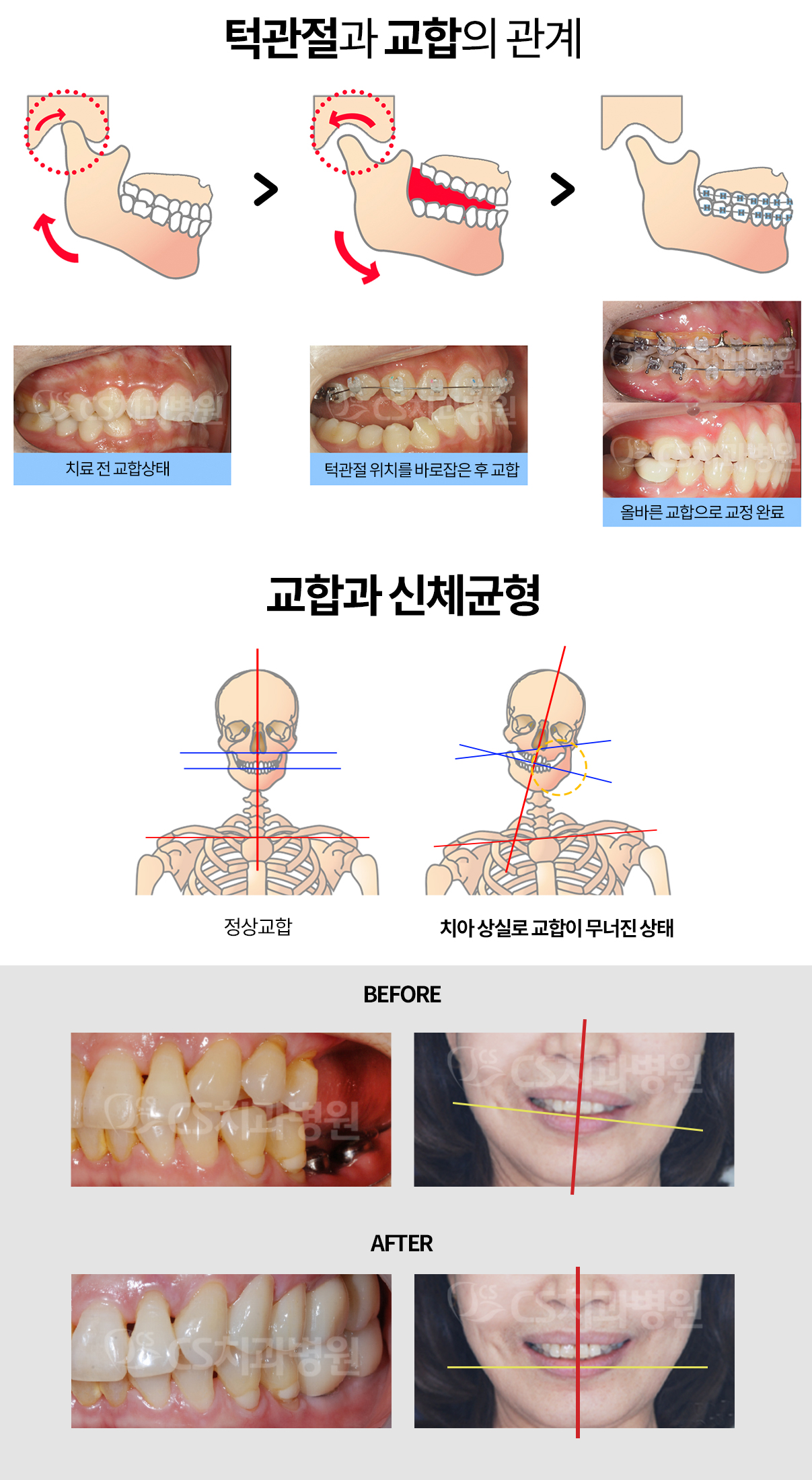
The Gothic arch examination(고딕아치 검사) is a precision bite analysis technique used at CS Dental Hospital to identify the true centric relation position of the jaw — where the jaw joint is in its most balanced, unstressed position. This is distinct from the habitual bite position, which is where most patients naturally close their teeth — often due to years of compensating around a misaligned bite.
By tracing jaw movements using the Gothic arch device, the clinician identifies: the centric relation (CR) position, any discrepancy between CR and the habitual bite (CO), lateral and protrusive jaw movement patterns, and whether there are specific interferences causing the jaw to deflect from its natural position.
This diagnostic process takes 30–45 minutes and provides the clinical foundation for all subsequent TMJ treatment decisions. Without this data, splint therapy and bite adjustment are essentially guesswork — which is why many patients at general clinics see limited improvement from generic nightguards.
- Identifies true centric relation jaw position
- Maps all jaw movement patterns (lateral, protrusive, retrusive)
- Locates specific bite interferences causing joint stress
- Provides the data for custom splint fabrication and bite equilibration
- Documents jaw position before and after treatment for objective comparison
Your TMJ Treatment Journey at CS Dental Hospital Busan
From precise jaw diagnosis to long-term symptom relief — a structured, evidence-based approach.
TMJ Consultation & History
Full symptom history, jaw joint palpation, range-of-motion check, bite assessment, and discussion of contributing factors (stress, posture, habits, prior dental work).
Gothic Arch Examination
Precision jaw movement mapping to identify true jaw position, interferences, and bite discrepancy. X-rays and CBCT where indicated for joint structural assessment.
Splint Fitting & Initial Relief
Custom occlusal splint fabricated based on Gothic arch data. Worn primarily at night. Follow-up at 2–4 weeks to assess muscle response and symptom reduction.
Definitive Bite Correction
Once TMJ is stabilised, definitive occlusion correction through bite equilibration, restorative dental work, or combined orthodontic treatment — depending on the root cause identified.
TMJ & Occlusion Treatment Cases — CS Dental Hospital Busan
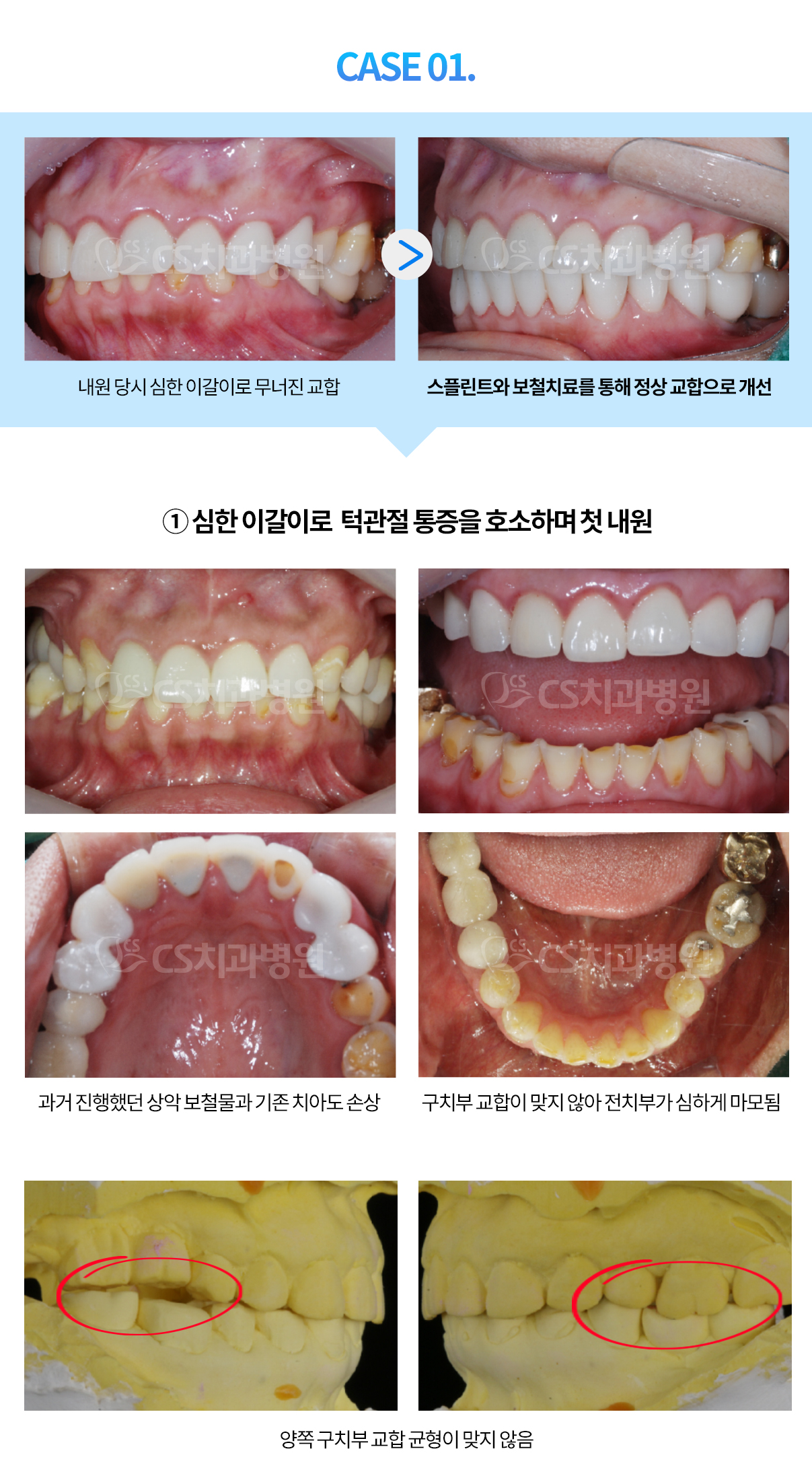
Bite Correction with Splint
Patient presenting with morning jaw pain and bilateral clicking. Gothic arch examination confirmed bite shift. Splint therapy resulted in significant symptom reduction within 6 weeks.
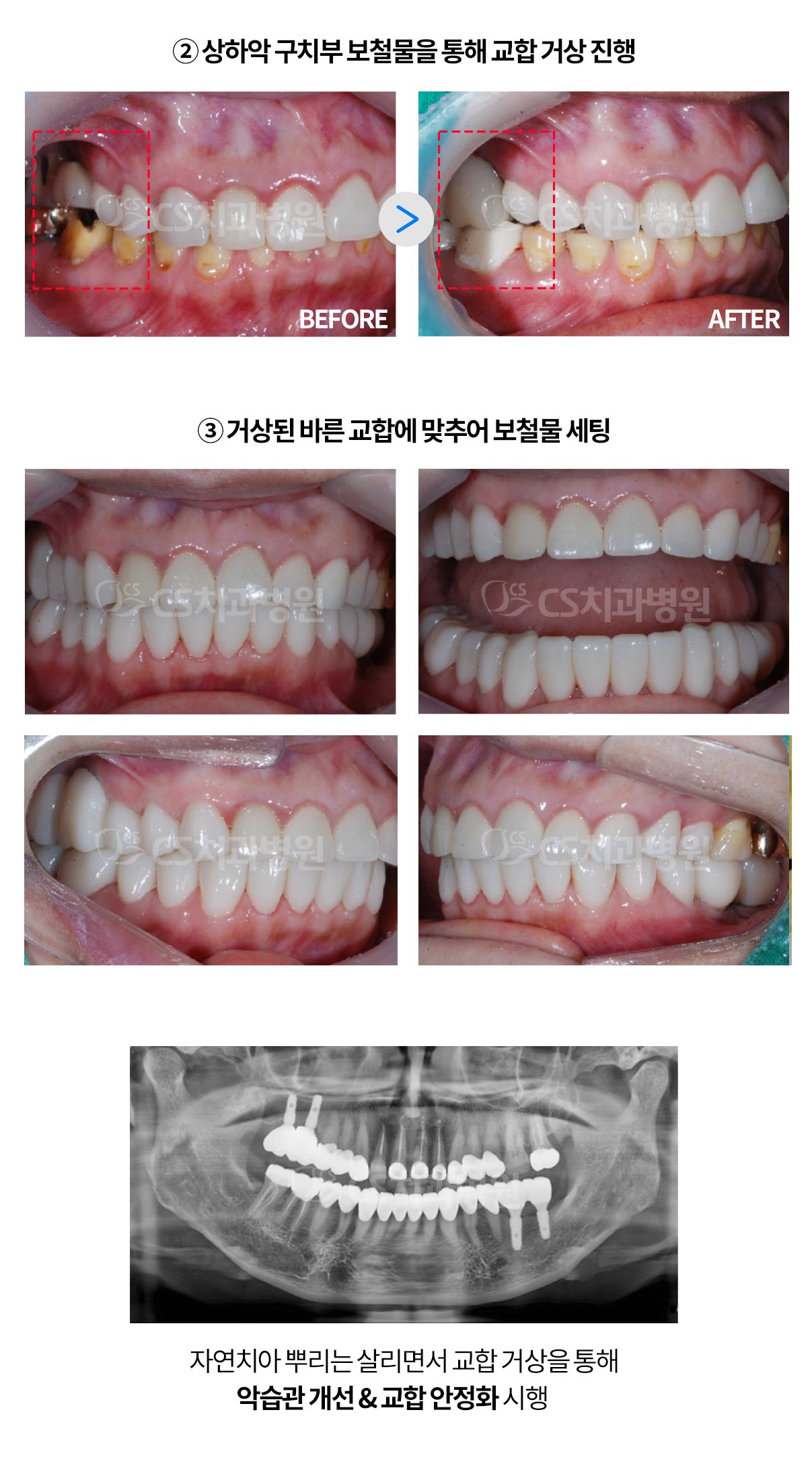
Occlusion Correction
Uneven bite with premature molar contact causing lateral jaw deviation. Selective equilibration over 3 sessions. Headaches resolved within 2 months of treatment.

Combined Ortho-TMJ Treatment
Patient needing orthodontic correction but with active TMJ symptoms. TMJ stabilised with splint therapy first, then orthodontic treatment commenced with joint health monitored throughout.
Who Should Seek TMJ Treatment in Busan?
✓ Seek TMJ Assessment If You Have:
- Jaw clicking, popping, or grinding sounds when opening or closing
- Morning jaw pain, soreness, or stiffness that improves through the day
- Headaches — especially temporal, behind the eyes, or upon waking
- Uneven bite — feeling one side of the bite contacts differently than the other
- Bruxism (teeth grinding) — especially if told by a partner or dentist
- Limited jaw opening or jaw that locks or deviates to one side when opening
ⓘ Important Considerations
- TMJ treatment at CS Dental is non-surgical — for advanced joint degeneration or disc perforation, surgical referral may be required
- TMJ symptoms have multiple causes — medical conditions (arthritis, neurological) must be ruled out alongside dental causes
- Short-stay international visitors can complete TMJ diagnosis and receive a splint during their Busan visit — longer-term definitive treatment requires follow-up
- Untreated bruxism continues to damage teeth even with splint therapy — addressing contributing stress and postural factors is important
TMJ Treatment Busan — Frequently Asked Questions
Common questions from international patients seeking TMJ and jaw joint treatment in Busan, Korea.
Can TMJ jaw pain be treated at a dental clinic in Busan?
What causes jaw clicking and pain?
Will a splint cure my TMJ?
Can I get a TMJ splint made during a short visit to Busan?
Is TMJ treatment available in English in Busan?
Book Your TMJ Consultation
in Busan — English OK
Specialist jaw joint diagnosis. Gothic arch examination. Custom splint therapy. Seomyeon Station, 1-min walk.